


Thames & Kosmos GeckoBot 2.0 Wall Climbing Robot Building Kit
Thames & Kosmos GeckoBot 2.0 Wall Climbing Robot Building Kit
Best For
Couldn't load pickup availability


Product Overview
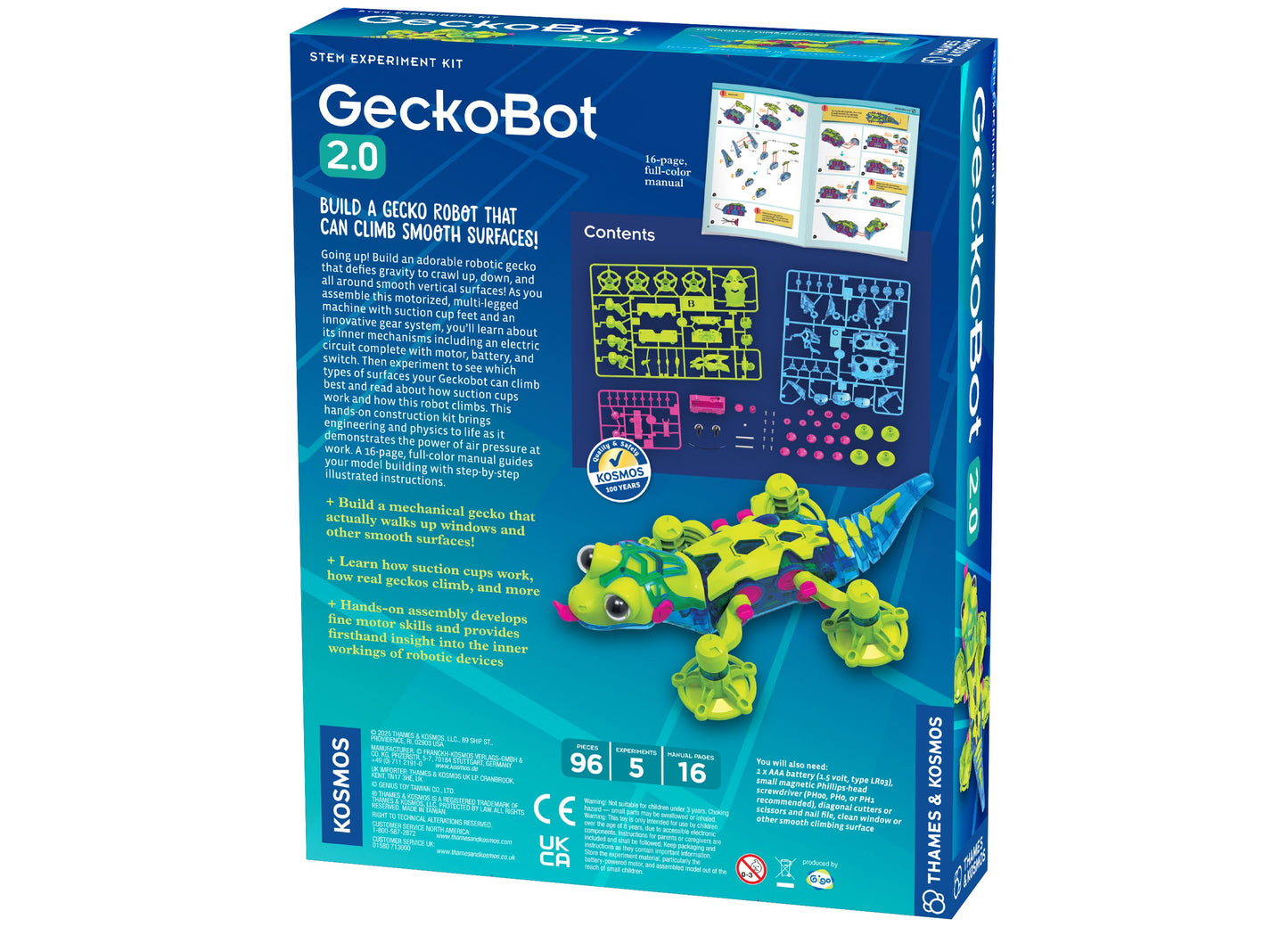
This motorized climbing robot grips smooth vertical surfaces with suction cup feet and crawls up walls, windows, and glass doors. Young engineers assemble the multi-legged GeckoBot piece by piece, building a working electric circuit with motor, battery, and switch while learning how air pressure makes the climbing action possible. The 16-page illustrated manual walks builders through each construction step, then explains the physics behind suction technology and encourages surface-testing experiments to see where the gecko climbs best.
- Wall-climbing robot uses suction cup feet to stick to and scale smooth vertical surfaces like glass and plastic
- Hands-on assembly teaches electric circuit basics, gear systems, and how air pressure creates suction grip
- Includes all parts needed to build the motorized gecko plus a full-color instruction manual
- Experiment-friendly design invites testing on different surfaces to observe which materials provide the strongest suction
- Demonstrates real engineering and physics principles through a build-it-yourself robot that actually defies gravity
You May Also Like


Full Details
Care Notes
- cleaning: Wipe plastic components with a damp cloth. Keep suction cups clean and free of dust for best climbing performance.
- storage: Store in a dry place. Keep small parts and assembled robot away from moisture to protect the electric circuit.
- material warnings: Contains small parts and functional motor. Keep batteries away from water.
Use Cases
- STEM education project for elementary school students learning about robotics and physics
- Rainy day activity for children interested in building and engineering
- Birthday gift for a child who enjoys hands-on construction kits
- Homeschool science curriculum supplement demonstrating air pressure principles
- Solo building project that results in an interactive climbing robot toy
- Introduction to electric circuits and motorized mechanisms for young learners
Skills Developed
- primary skill: Engineering thinking through hands-on construction of a functional motorized robot
- fine motor: Precision assembly of small mechanical parts, gears, and electric circuit components
- scientific reasoning: Hypothesis testing through surface experiments and observation of air pressure principles
- problem solving: Troubleshooting assembly steps and optimizing robot performance on different surfaces
Age Suitability
- minimum safe age: 8 years
- ideal age range: 8-12 years
- developmental fit: 8-10 years: Perfect match for developing fine motor skills needed for assembly and understanding basic physics concepts through hands-on building. 11-12 years: Engages interest in robotics and engineering while providing accessible entry point to electric circuits and mechanical systems.
Play Patterns
- primary play type: Constructive building followed by experimental play and testing
- play structure: Initial assembly session of 1 to 2 hours, followed by ongoing experimentation with different climbing surfaces and angles
- social context: Solo building activity with opportunities to demonstrate the completed robot to family and friends
- adult involvement: Minimal supervision needed for assembly. Adults can facilitate discussion about physics concepts and circuit mechanics.
- play progression: Begins with following step-by-step instructions to build the robot, advances to independent experimentation with surfaces and climbing angles, deepens with reading about suction technology and air pressure science
- session length: Initial build takes 60 to 120 minutes. Experimentation and play sessions typically last 20 to 45 minutes.
Why It Works
- primary benefit: Transforms abstract physics concepts like air pressure and electric circuits into a tangible, working robot that children build themselves.
- secondary benefit: Combines engineering construction with active experimentation, allowing children to test and observe scientific principles in real time.
What Makes It Fun
- Build a robotic gecko that actually crawls up walls. Air pressure keeps it gripping smooth surfaces while its motorized legs do the climbing.
Why They'll Love It
- * Climbs up walls and windows using air pressure tech * Build a motorized gecko robot from the ground up * Demonstrates real physics through vertical crawling
Customer Q&A
Does it require batteries?
Yes, the GeckoBot 2.0 requires batteries to power the electric motor that drives the climbing mechanism.
What does the robot actually do once built?
The completed robot crawls up, down, and around smooth vertical surfaces like walls and windows using motorized suction cup feet.
Are assembly instructions included?
Yes, the kit includes a 16-page full-color instruction manual with step-by-step assembly guidance.
What will children learn from building this?
Children learn about electric circuits, motor mechanics, gear systems, and how air pressure enables suction cups to grip vertical surfaces.
What surfaces can the GeckoBot climb?
The GeckoBot climbs smooth vertical surfaces best, and the kit includes experiments to test different surface types.
Is this a one-time build or can it be rebuilt?
This is a construction kit that can be disassembled and rebuilt multiple times as children experiment with the mechanism.


